


सूचना प्रविधि अधिकृतको आवेदन
Summary
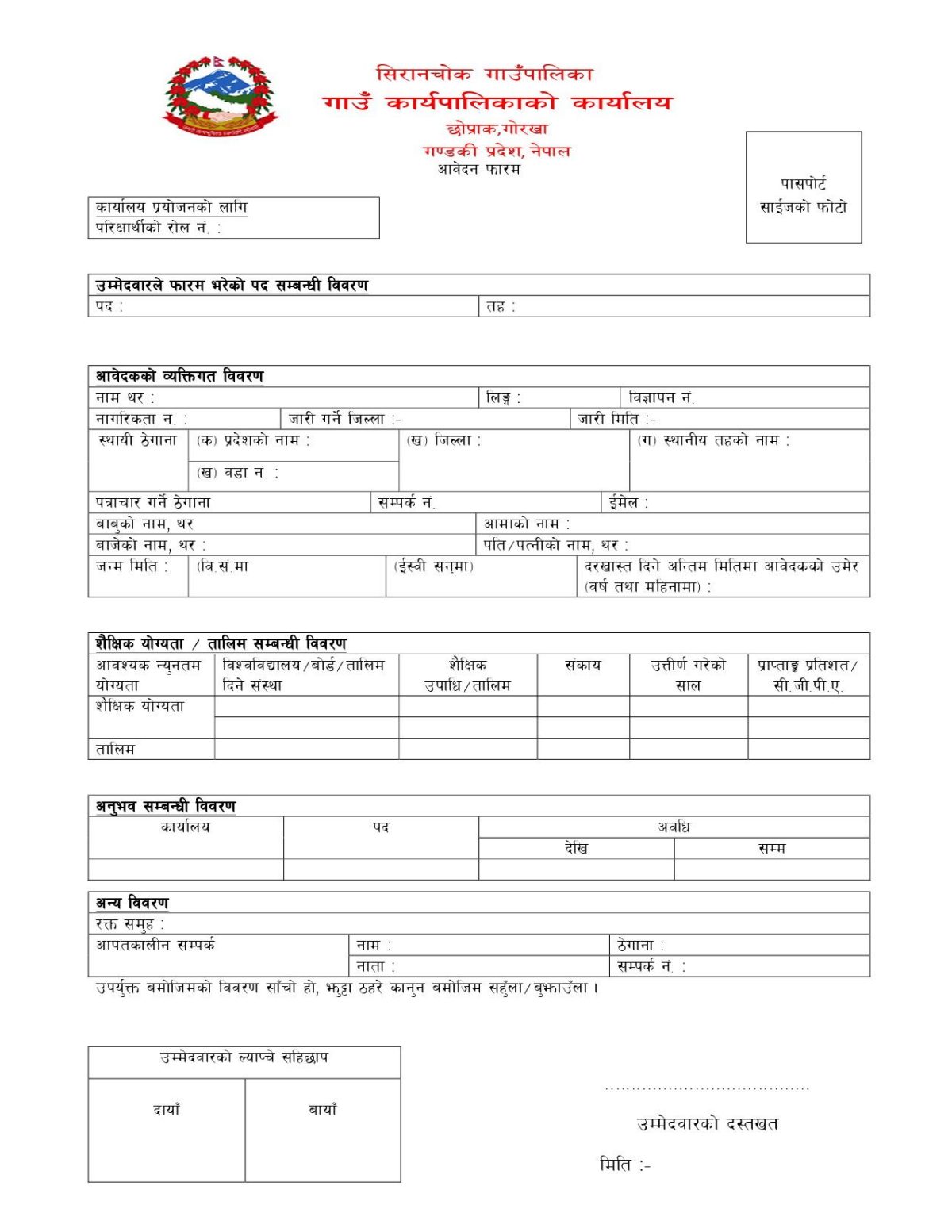
गाउँ कार्यपालिकाव्को क्रार्यात्लय 'छोप्राक,गोरखा आवेदन फारम पाट aad कार्यालय प्रयोजनको लागि साईजको फोटो परिक्षार्थीको रोल नं. : उम्मेदवारले फारम भरेको पद सम्बन्धी विवरण पद तह : आवेदकको व्यक्तिगत विवरण नाम थर : लिङ्ग : विज्ञापन नं. स्थायी ठेगाना | (क) प्रदेशको नाम : (ख) जिल्ला : (ग) स्थानीय तहको नाम…
Auto-generated and may contain errors. Check the original notice before you act on it.
Files
- 8b43a5d3-7939-4e76-a1c4-d10841a344bc.pdfPDF · 2 pages · 655 KBOpen
- bed4ce10-5cfa-43f3-bcbd-90cfc0cd10fd.pdfPDF · 6 pages · 491 KBOpen
Key details
- Organization
- Siranchowk Rural Municipality
- Industry
- Local Government
- Category
- Vacancy
- Published
- Notice date
- Fiscal year
- FY 2083/84
- Source
- View on the original website
Text extracted automatically from the notice (may contain errors)
8b43a5d3-7939-4e76-a1c4-d10841a344bc.pdf
सिरानचोक गाउँपालिका गाउँ कार्यपालिकाव्को क्रार्यात्लय 'छोप्राक,गोरखा गण्डकी प्रदेश, नेपाल आवेदन फारम पाट aad कार्यालय प्रयोजनको लागि साईजको फोटो परिक्षार्थीको रोल नं. : उम्मेदवारले फारम भरेको पद सम्बन्धी विवरण पद तह : आवेदकको व्यक्तिगत विवरण नाम थर : लिङ्ग : विज्ञापन नं. नागरिकता नं. : जारी गर्ने जिल्ला :- जारी मिति :- स्थायी ठेगाना | (क) प्रदेशको नाम : (ख) जिल्ला : (ग) स्थानीय तहको नाम : (@) वडा नं. : पत्राचार गर्ने ठेगाना सम्पर्क न. ईमेल : बाबुको नाम, थर आमाको नाम : बाजेको नाम, थर : पति/पत्नीको नाम, थर : जन्ममिति: ।(विसंमा (ईस्वी सनमा) दरखास्त दिने अन्तिम मितिमा आवेदकको उमेर (वर्ष तथा महिनामा) : शैक्षिक योग्यता / तालिम सम्बन्धी विवरण योग्यता दिने संस्था आवश्यक न्युनतम | विश्वविद्यालय /बोर्ड / तालिम शैक्षिक उपाधि /तालिम संकाय उत्तीर्ण गरेको | rears प्रतिशत / साल सीजीपीए. शैक्षिक योग्यता तालिम अनुभव सम्बन्धी विवरण कार्यालय अर्वाधच देखि सम्म अन्य विवरण रक्त समुह: आपतकालीन सम्पर्क नाम : ठेगाना : नाता: सम्पर्क नं : उम्मेदवारको ल्याप्चे सहिछाप बायाँ उपर्युक्त बमोजिमको विवरण साँचो हो, झुट्टा ठहरे कानुन बमोजिम सहुँला/ बुझाउँला | उम्मेदवारको दस्तखत मिति :- परिक्षार्थीले भर्ने (क) नाम, ae: (@) पद: (घ) परीक्षा केन्द्र : (च) उम्मेदवारको दस्तखतको : सिरानचोक गाउँपालिका गाउँ कार्यपालिकाक्को कार्यालय 'छोप्राक,गोरखा गण्डकी प्रदेशा, ATT प्रवेश-पत्र “ote साईजको फोटो (ग) de: (ङ) विज्ञापन नं. गाउँ/नगर कार्यपालिकाको कार्यालयले भर्ने यस सिरानचोक गाउँपालिका गाउँकार्यपालिकाको कार्यालयबाट लिईने उक्त पदको परीक्षामा तपाईलाई सम्मिलित हुन अनुमति दिईएको छ । विज्ञापनमा तोकिएको शर्त नपुगेको ठहर भएका जुनसुकै अवस्थामा पनि यो अनुमति eT रोल नम्बर : (कर्मचारीको दस्तखत) डक परिक्षार्थीले भर्ने (क) नाम, थर : (@) पद: (घ) परीक्षा केन्द्र : (कार्यालयको छाप) सिरानचोक गाउँपालिका गाउँ कार्यपालिकाव्को क्रार्यात्लय 'छोप्राक,गोरखा गण्डकी प्रदेश, नेपाल प्रवेश-पत्र (तह पासपोर्ट त साईजको फोटो (डङ) विज्ञापन नं. (च) उम्मेदवारको दस्तखतको : गाउँ /नगर कार्यपालिकाको कार्यालयले भर्ने यस सिरानचोक गाउँपालिका गाउँकार्यपालिकाको कार्यालयबाट लिईने उक्त पदको परीक्षामा तपाईलाई सम्मिलित हुन अनुमति दिईएको छ । विज्ञापनमा तोकिएको शर्त नपुगेको ठहर भएका जुनसुकै अवस्थामा पनि यो अनुमति ee | रोल नम्बर : (कर्मचारीको दस्तखत) (कार्यालयको छाप)
bed4ce10-5cfa-43f3-bcbd-90cfc0cd10fd.pdf
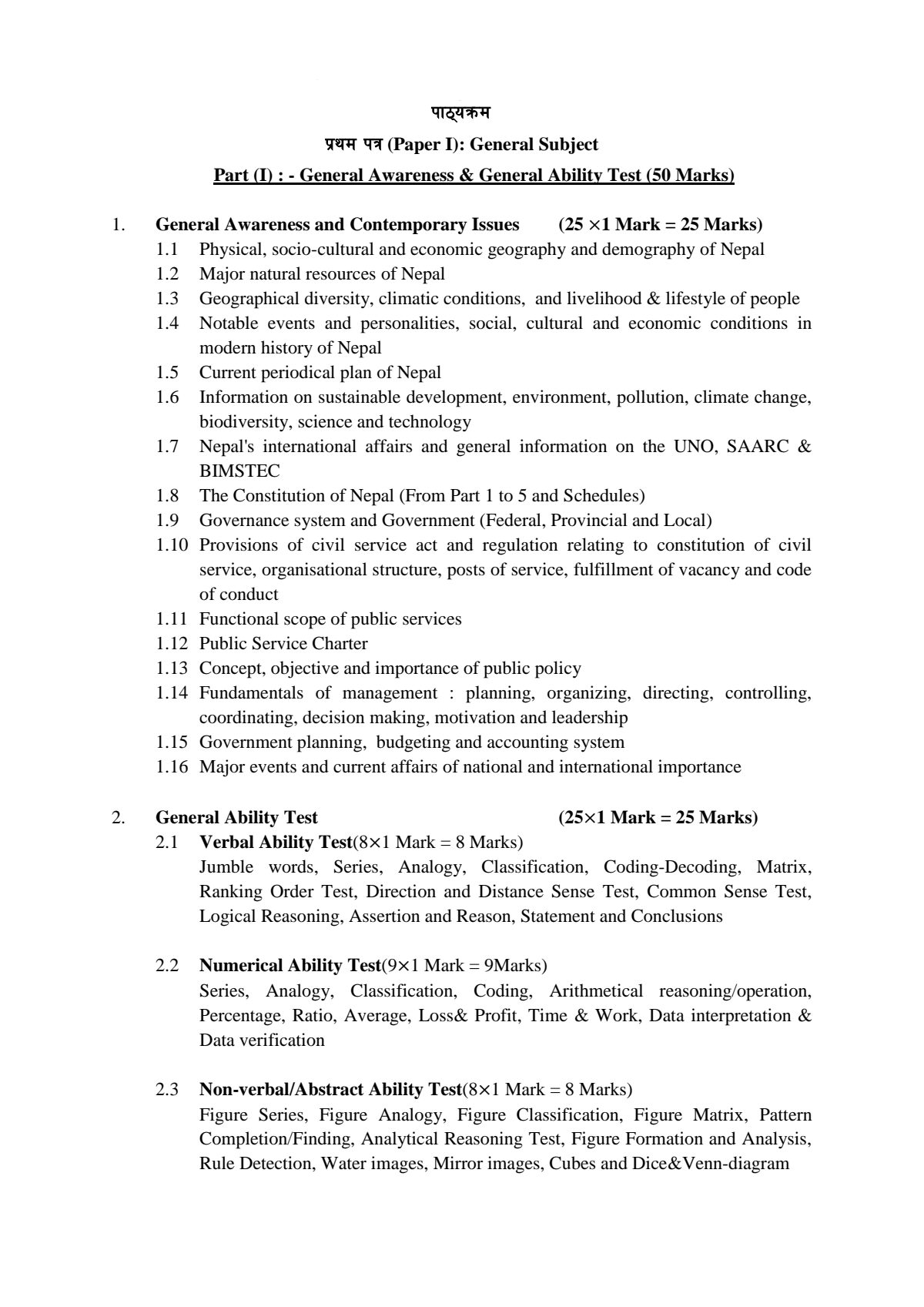
पाठयक्रम प्रथम TW (Paper I): General Subject Part (I) : - General Awareness & General Ability Test (50 Marks) General Awareness and Contemporary Issues (25 X1 Mark = 25 Marks) 1.1 Physical, socio-cultural and economic geography and demography of Nepal 1.2 Major natural resources of Nepal 1.3 Geographical diversity, climatic conditions, and livelihood & lifestyle of people 1.4 Notable events and personalities, social, cultural and economic conditions in modern history of Nepal 1.5 Current periodical plan of Nepal 1.6 Information on sustainable development, environment, pollution, climate change, biodiversity, science and technology 1.7 Nepal's international affairs and general information on the UNO, SAARC & BIMSTEC 1.8 The Constitution of Nepal (From Part 1 to 5 and Schedules) 1.9 Governance system and Government (Federal, Provincial and Local) 1.10 Provisions of civil service act and regulation relating to constitution of civil service, organisational structure, posts of service, fulfillment of vacancy and code of conduct 1.11 Functional scope of public services 1.12 Public Service Charter 1.13 Concept, objective and importance of public policy 1.14 Fundamentals of management : planning, organizing, directing, controlling, coordinating, decision making, motivation and leadership 1.15 Government planning, budgeting and accounting system 1.16 Major events and current affairs of national and international importance General Ability Test (25X1 Mark = 25 Marks) 2.1 Verbal Ability Test(8x 1 Mark = 8 Marks) Jumble words, Series, Analogy, Classification, Coding-Decoding, Matrix, Ranking Order Test, Direction and Distance Sense Test, Common Sense Test, Logical Reasoning, Assertion and Reason, Statement and Conclusions 2.2 Numerical Ability Test(9X 1 Mark = 9Marks) Series, Analogy, Classification, Coding, Arithmetical reasoning/operation, Percentage, Ratio, Average, Loss& Profit, Time & Work, Data interpretation & Data verification 2.3 Non-verbal/Abstract Ability Test(8x 1 Mark = 8 Marks) Figure Series, Figure Analogy, Figure Classification, Figure Matrix, Pattern Completion/Finding, Analytical Reasoning Test, Figure Formation and Analysis, Rule Detection, Water images, Mirror images, Cubes and Dice&Venn-diagram पाठयक्रम Part (II) : - General Technical Subject (50 Marks) Computer Fundamentals (10%) 1.1 Computers, Kinds of Computers in respect of size and function 1.2 Generation of Computers 1.3 Components and Architecture of Computers, Connecting the Components, 1.4 Getting started: Orientation to personal computers, system unit, Starting the computers 1.5 Input Devices: keyboard, mouse, other input devices 1.6 Processing: CPU, Memory 1.7 Storages devices: Overview of Storage Devices, Floppy Disk Drive, Hard Drive, Universal Serial Bus(USB) Devices and Other Storage Devices 1.8 Output devices: Monitors, Printers, Modems, Soundboards 1.9 Dos survival guide: Using Command Prompt, Creating and using AUTOEXEC.BAT and CONFIG.SYS 1.10 Windows survival guide: Windows Desktop, Program Manager, Organizing the Desktop, File Manager 1.11 Application software: Using Application Software 1.12 Windows Explorer, E-mails, Internet, Intranet, Extranets, Ethernet, HTTP 1.13 Computer Viruses, Antivirus Data Structure and Algorithms (8%) 2.1 Fundamental of Data Structures, Abstract Data types 2.2 Lists, Linked Lists, Stacks 2.3 Queues, Priority Queue 2.4 Trees: Traversal, Implementations, Binary Trees, Binary Search Trees, Balanced Search Trees, AVL Trees 2.5 Indexing Methods. Hashing Trees, Suffix Trees 2.0 Worst-Case and Expected time Complexity 2.7 Analysis of Simple Recursive and Nonrecursive Algorithms 2.8 Searching, Merging and Sorting 2.9 Introductory Notions of algorithm design: Divide-and-Conquer, Dynamic Programming, Greedy Methods, Backtracking 2.10 Graph algorithms: Depth-first Search and Breadth-first Search, Shortest Path Problems, Minimum Spanning Trees, Directed Acyclic Graphs System Analysis and Design (10%) 3.1 Definition of the System, System Owner, System User, System Designers and system Builders, System Analysts, Variations on the System Analyst title, System life Cycle 3.2 Joint Application Development (JAD): JAD definition, JAD purpose, JAD Philosophy, JAD Scope 3.3 Involved in a JAD: Sponsor, Business Users, System Analyst 3.4 Roles of JAD Group Member: Project Leader, Record Keeper, Time Keeper. 3.5 The System Design Environment: Development Process, Management Process, System Structure, Basic Component of Computer based Information System, Personal/ Centralized/Distribution System पाठयक्रम 3.6 Concept formations: Introduction, Finding the Problem, Evaluating the Proposal, Technical Feasibility, Operational Feasibility, Economic Feasibility. 3.7 Requirements analysis: Representing System Analysis Model, Requirement Model, Design Model 3.8 Development Process: Design Method 3.9 Entity Relationship Diagram (E-R Diagram): Notations, Entities: Strong Entities, Weak Entities, Attributes: Simple and Composite, Single Valued and Multiple Valued, Null and Derived Attribute 3.10 Relationship Sets: Degree of Relationship and Cardinality Relationship, Specialization, Generalization, Aggregation 3.11. Data Flow Diagrams (DFDs): Introductions, Data flow Diagram, Symbol, Files or data store, External entities, Data flows, 3.12 Describing System by Data Flow Diagram: Context diagram, Top level DFD, Expansion Level DFD, Conversions of Data. 3.13. Object Modeling: Object -Oriented Concept, Object Structure, Object Feature, Class and Object 3.14. Representation: Association, Composition, Inheritance, Multiple Inheritances 3.15 Modeling: Use Case Diagram, State Diagram, Event Flow Diagram. 3.16 Documentation: Automatic and Manual System Operating Systems (10%) 4.1 Definittion, Development and Functions of Operating Systems 4.2 Basic components of the Operating Systems, Information Storage and Management Systems 4.3 Disk Allocation and Scheduling Methods, Basic Memory Management strategies, Virtual Memory Management Techniques, Define a Process and features of the Process Management System 4.4 Features of Process Scheduling; List the features of Inter-Process Communication and Deadlocks 4.5 Concepts of Parallel and Distributed Processing, Identify Security Threats to Operating Systems 4.6 Overview of the MS-DOS Operating System 4.7 Introduction to the Windows Family of Products, Unix Family of Products, Linux Family of Products 4.8 Introduction to Windows Networking 4.9 Windows Architecture, Linux Architecture 4.10 Troubleshooting Windows & Linux 4.11 Managing Network Printing 4.12 Managing Hard Disks and Partitions 4.13 Monitoring and Troubleshooting Windows 4.14 Users, Groups and Permission Linux and Windows Database Management System and Design (14%) 5.1 Introduction, A Database Model, Relational Database Model, Integrity, RDBMS 5.2 SQL and Embedded SQL 5.3 Writing Basic SQL SELECT Statements 5.4 _ Restricting and Sorting data 5.5 Single Row Functions 5.6 Displaying Data from Multiple Tables पाठयक्रम 5.7 Aggregation Data Using Group Functions 5.8 Sub Queries, Manipulating Data and Creating &Managing Tables 5.9 Creating Views and Controlling User Access 5.10 Using Set Operators, Datetime Function 5.11 Database Design: Logical Design, Conceptual Design, Mapping Conceptual to Logical, Pragmatic issues, Physical Design, Integrity and Correctness, Relational Algebra, Relational Calculus 5.12 Normalization: INF, 2NF, 3NF, BCNF, 4NF,5SNF, DKNF 5.13 Architecture of DBMS: Client-server, Open Architectures, Transaction Processing, Multi-User & Concurrency, and Backup & Recovery Database 5.14 Basic Concept of major RDBMS products: Oracle, Sybase, DB2, SQL Server and other Databases Programming Language (8%) 6.1 Overview of Programming Language: History, Programming Paradigms, The role of Language translates in the Programming Process. 6.2 Fundamental Issues in Language Design. 6.3 Virtual Machines, Code Generation, Loop Optimization. 6.4 Concept of Procedural Programming, Structural Programming, Object-Oriented Programming. 6.5 Concept of C programming, C++ Programming, 6.6 Java Programming for Declaration, Modularity and Storage Management Software Development Networking (10%) 7.1 Basic Network Theory: Network Definition, Network Models, Connectivity, Network Addressing. 7.2 Network Connectivity: Data Package, Establishing a Connection, Reliable Delivery, Network Connectivity, Noise Control, Building Codes, Connection Devices 7.3 Advanced Network Theory: OSI model, Ethernet, Network Resources, Token ring, FDDI, Wireless Networking 7.4 Common Network Protocols: Families of Protocols, NetBEUI, Bridge and Switches, TCP/IP Protocol, Building TCP/IP Network, TCP/IP Suite 7.5 TCP/IP Services: Dynamic Host Configuration Protocol, DNS Name Resolution, NetBIOS support, SNMP, TCP/IP Utilities, FTP 7.6 Network LAN Infrastructure: LAN Protocols on a Network, IP Routing, IP Routing Tables, Router Discovery Protocols, Data Movement in a Routed Network, Virtual LANs(VLANS) 7.7 Network WAN Infrastructure: WAN Environment, Wan Transmission Technologies, Wan Connectivity Devices, Voice Over Data Services 7.8 Remote Networking: Remote Networking, Remote Access protocols, VPN Technologies 7.9 Computer Security: Computer Virus, Worm, Trojan Horse 7.10 Network Security: Introduction, Virus Protection, Local Security, Network Access, Internet Security 7.11 Disaster Recovery: Need for Disaster Recovery, Disaster Recovery plan, Data backup, Fault Tolerance
 Like
0
 Views
0
 Comments
0
 Share
0

Save

Report